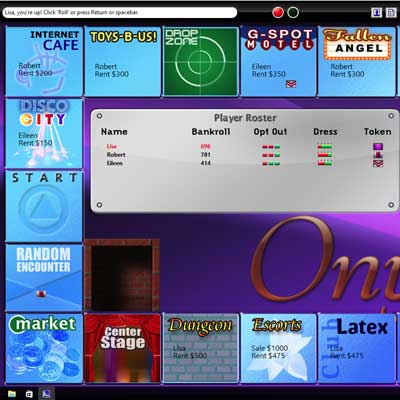
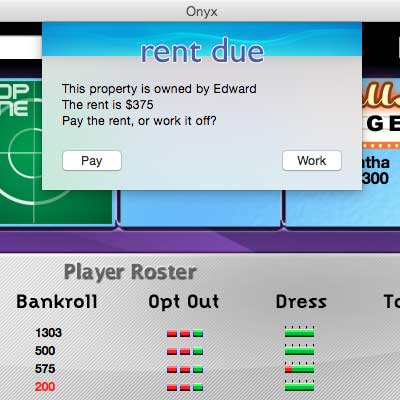
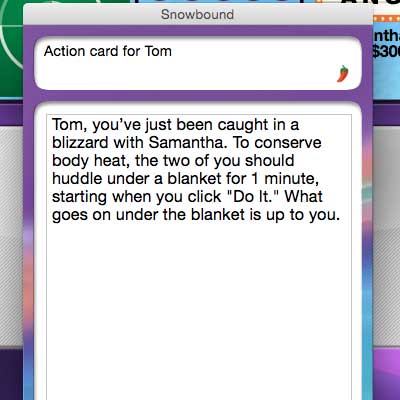
Onyx is a computer sex game. Move around the board buying up properties. If you land on a property that is owned by somebody else, you must either pay rent or work off the debt! Players work off debt with all kinds of intimate actions, from mild to kinky. As the game progresses, so does the action! Play with people you are intimate with, or want to be!
You can work off the debt by being assigned fun, sexy erotic actions.
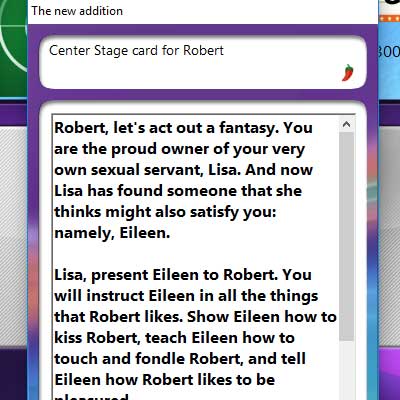
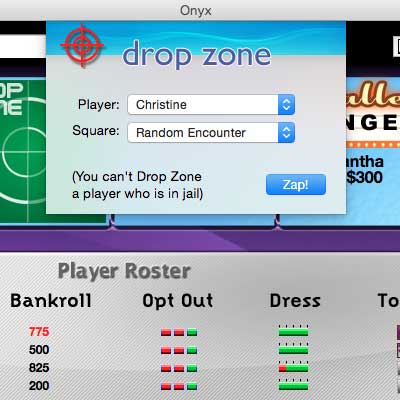
Look out for special squares! If you land on the Torture Chamber, you must draw a "torture card" with an erotic torture on it. At Center Stage, you are put on display; in the Random Encounter square, you will be assigned an erotic action with another player; and on the Fate squares, the luck of the draw dictates your fate.
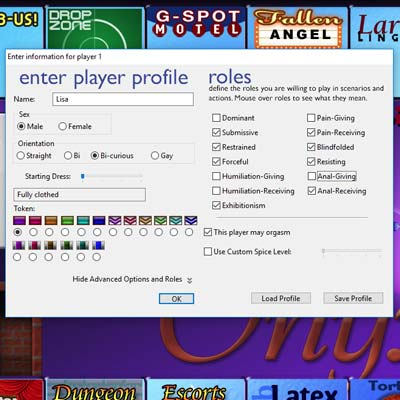
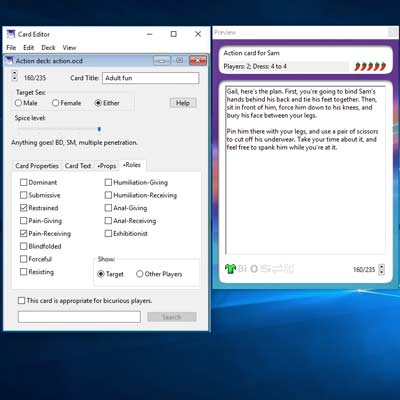
You control the "spice" of the erotic actions, from harmless fun to wild, anything-goes kink. You choose "roles," which tell the game what kinds of actions you prefer to be involved in. If you don't like being tied up, just tell Onyx that you will not accept the "bondage" role.
Onyx 3.6 and earlier did not work on Macs requiring 64-bit native apps. Onyx 3.7 now works on modern Macs, and is optimized to run natively on Apple Silicon Macs. A version of Onyx that runs natively on Windows ARM devices is also available!
UPDATE: Some Mac users were reporting an error saying “Onyx 3.7.app can’t be opened because Apple cannot check it for malicious software.” I have updated the app to address this issue; it should work properly now.
Onyx runs on Macs (OS X 10.14 or later), Windows (Windows 7 or later), Windows for ARM (Windows 11 or later), and x86 Linux (GTK 2.0+).
Onyx is available for free download. The free version can only be played on the mildest two "spice level" settings. Onyx can be registered by paying the $35 shareware fee. Registration gives you a serial number to unlock the full version, and it also gives you the Card Editor program, which you can use to create your own card decks.
Onyx contains explicit descriptions of sexual acts. Some of the high-level actions in Onyx describe erotic actions like bondage and power exchange.
IF YOU ARE OFFENDED BY SEXUAL ACTIONS, BEHAVIOR, OR DESCRIPTIONS, DON'T DOWNLOAD THIS SOFTWARE!
If you are under the legal age of consent or live in a place where this material may be restricted or illegal, YOU SPECIFICALLY DO NOT HAVE A LICENSE TO OWN OR USE THIS COMPUTER PROGRAM. There is absolutely no warranty of any kind, expressed or implied. Use it at your own risk; the author disclaims all responsibility for any kind of damage to your computer, your car, your refrigerator, or to anything else.
By downloading Onyx, you certify that you are an adult, age 18 or over, and that you consent to see materials of a sexual nature.
Bibigon Vibro School was not a refuge from seriousness; it was a training ground for attending to small things with large respect. Children learned to measure time by the spin of a flywheel and to forgive by the length of a borrowed hammer. They left with hands that remembered how to coax a dead radio back to speech, how to solder two broken friendships with shared labor, how to file a complaint and fold it into a paper bird so it could be read aloud, gentled, and returned.
In 2014 the school faced a possible closure. The council sent letters, precise and polite, full of terms like "zoning variance" and "public safety." The teachers answered with a week-long festival of vibrations: machines that hummed lullabies, benches that turned into shortwave transmitters, a parade of students banging pots and reading aloud from the rain archives. The town came out, curious at first, then moved; neighbors began to hum along, and the letters lost their urgency as officials found themselves smiling on the steps, unable to explain why.
Between two flaking brick towers on the edge of town, the Bibigon Vibro School announced itself not with a gate but with a hum. It was 2012 when I first followed that persistent vibration—a low, curious tremor underfoot that seemed to be part engine, part heartbeat—and found the school's crooked courtyard alive with children who moved like people learning new languages with their shoulders and knees.
2013 brought the archive project. Each student was assigned a single day's worth of summer rain to catalog: the tempo of drops, the way water rearranged chalk drawings, the notes it changed from puddles when struck with a pebble. They taped recordings to old library cards and stapled them into spiral notebooks. The headmistress, a woman who’d once been a mapmaker, told them that knowledge was a public instrument if you learned to open it, and that the archive should be free—free to touch, free to remix, free to fail.
"Vibro" was not brand name so much as method: vibration as pedagogy. Students learned to read the frequency of choices—soft vibrations meant disagreement, a buzz meant curiosity, a steady thrum meant consensus. They charted disagreement on paper, then traced it on copper wire until the wires sang back, teaching physics by making the classroom itself vibrate with discovery. Geometry was found in the tilt of a teacher’s hat; algebra lived in the pattern of footsteps across the yard.
The courtyard still hums in memory—sometimes when a train passes, sometimes when a child rattles a chain-link fence—but mostly as a reminder that learning can be a public, noisy thing: imperfect, improvisational, and, if you listen closely, vibrantly free.
Bibigon Vibro School was not a refuge from seriousness; it was a training ground for attending to small things with large respect. Children learned to measure time by the spin of a flywheel and to forgive by the length of a borrowed hammer. They left with hands that remembered how to coax a dead radio back to speech, how to solder two broken friendships with shared labor, how to file a complaint and fold it into a paper bird so it could be read aloud, gentled, and returned.
In 2014 the school faced a possible closure. The council sent letters, precise and polite, full of terms like "zoning variance" and "public safety." The teachers answered with a week-long festival of vibrations: machines that hummed lullabies, benches that turned into shortwave transmitters, a parade of students banging pots and reading aloud from the rain archives. The town came out, curious at first, then moved; neighbors began to hum along, and the letters lost their urgency as officials found themselves smiling on the steps, unable to explain why. bibigon vibro school 2012 14 free
Between two flaking brick towers on the edge of town, the Bibigon Vibro School announced itself not with a gate but with a hum. It was 2012 when I first followed that persistent vibration—a low, curious tremor underfoot that seemed to be part engine, part heartbeat—and found the school's crooked courtyard alive with children who moved like people learning new languages with their shoulders and knees. Bibigon Vibro School was not a refuge from
2013 brought the archive project. Each student was assigned a single day's worth of summer rain to catalog: the tempo of drops, the way water rearranged chalk drawings, the notes it changed from puddles when struck with a pebble. They taped recordings to old library cards and stapled them into spiral notebooks. The headmistress, a woman who’d once been a mapmaker, told them that knowledge was a public instrument if you learned to open it, and that the archive should be free—free to touch, free to remix, free to fail. In 2014 the school faced a possible closure
"Vibro" was not brand name so much as method: vibration as pedagogy. Students learned to read the frequency of choices—soft vibrations meant disagreement, a buzz meant curiosity, a steady thrum meant consensus. They charted disagreement on paper, then traced it on copper wire until the wires sang back, teaching physics by making the classroom itself vibrate with discovery. Geometry was found in the tilt of a teacher’s hat; algebra lived in the pattern of footsteps across the yard.
The courtyard still hums in memory—sometimes when a train passes, sometimes when a child rattles a chain-link fence—but mostly as a reminder that learning can be a public, noisy thing: imperfect, improvisational, and, if you listen closely, vibrantly free.