
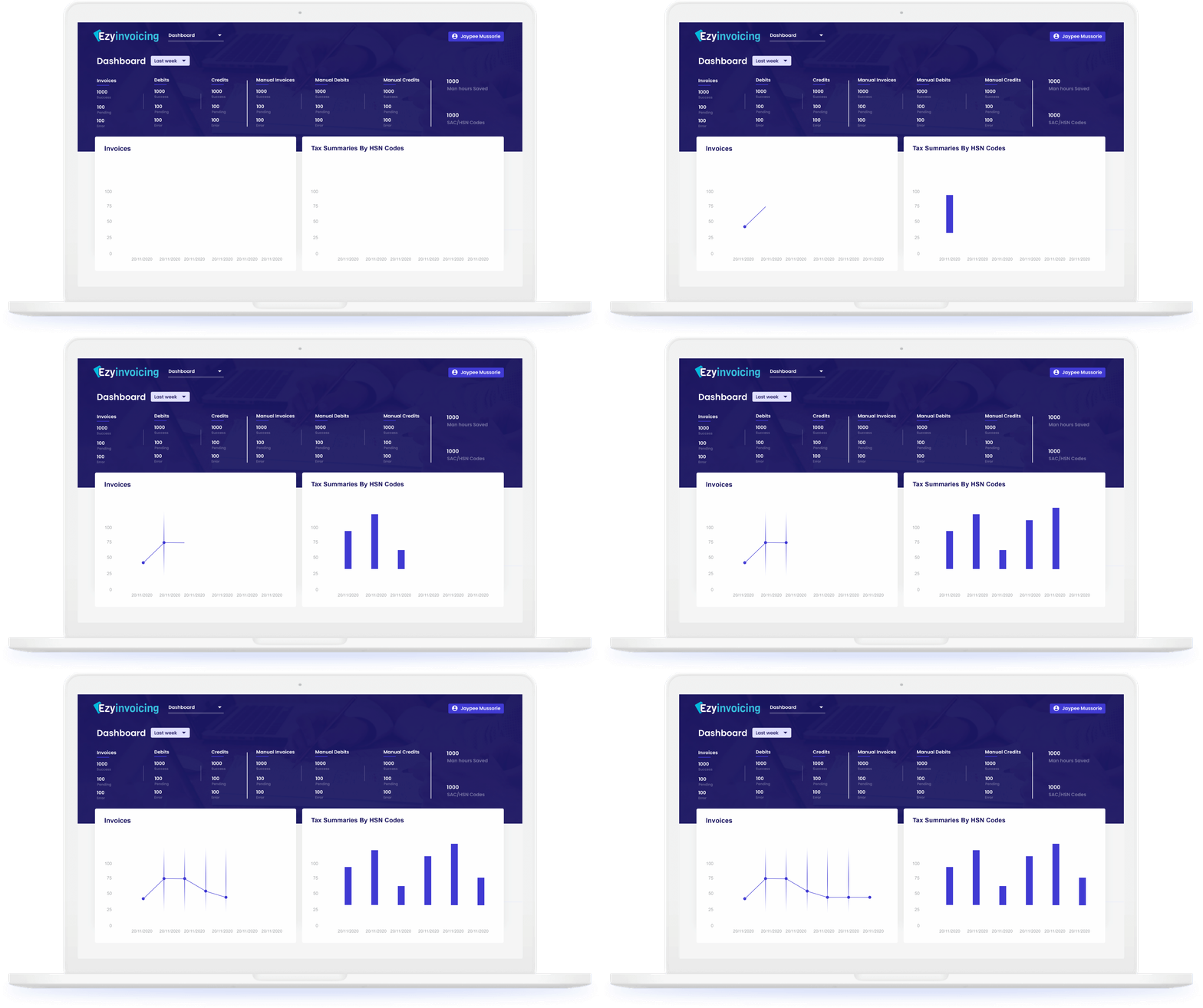

Generates invoices directly through any PMS/POS system without modifying existing processes

Supports robust error handling mechanism to ensure you generate
e-invoices without any
worries

Available both on cloud or on-premise deployment models as per client's convenience

One-click reconciliation of e-Invoice data with GSTR-1 data to take care of your compliance needs

Ability to configure custom templates as per your business need to print
e-Invoices in a
single click




Equipped with an SSL encryption for all on cloud deployments & also offer 2F Authentication mechanisms

24x7 in-house technical support and advisory services, dedicated key account manager and priority access to NIC

Affordable price, high-end product and great value. No other hidden charges

Allows integrations with multiple third party systems/partners to leverage the best out of its friendly RESTFUL API architecture

Best-in-class tech first company with deepest domain expertise in hospitality

Taken together, the fragment is more than a filename: it's a compact history. It suggests the global journey of a single film—released in 2006, embraced and reinterpreted, formatted into a portable copy that speaks in two tongues. It’s the story of how media travels: through market demand, home viewing habits, and the tireless human impulse to make art understandable and usable across borders.
"Download 300 -2006- Dual Audio -Hindi-English-" begins like a breadcrumb left on a cluttered bookshelf: fragments of a title, a date, and a promise of two languages folded into one file. To make sense of it, imagine tracing those fragments into a single, human story. Download 300 -2006- Dual Audio -Hindi-English- ...
First, "300" suggests the film's marquee: a stylized, mythic retelling of ancient battle—spartan silhouettes, thunderous drums, and a visual language built on wide stances and slow-motion clashes. The number alone carries weight; it points to a title that people recognize and argue over in forums, at parties, and in late-night debates about spectacle versus substance. Taken together, the fragment is more than a
The ellipsis at the end—"..."—is a quiet invitation. It hints at missing metadata: file format (MP4, MKV), resolution (480p, 720p, 1080p), quality (BRRip, HDRip), or the source (DVD/BD rip, cam, remaster). It could also point to legal gray areas: who made the dual-audio file, whether it preserves original credits, or how faithfully the Hindi track matches the actors’ rhythms and intonations. In another reading, the ellipsis is sentimental: a reminder that every shared file carries traces of the person who uploaded it—their choices in encoding, their care for synchronization, their reasoning for pruning or preserving the director’s commentary. "Download 300 -2006- Dual Audio -Hindi-English-" begins like
"Dual Audio -Hindi-English-" is the most human part of the fragment. It speaks to translation, adaptation, and reach. Dual audio tracks mean the same visual story carries two voices: the original performance in English and a Hindi track that lets another large audience step inside the film without subtitles. Dual audio versions are a bridge—sometimes literal, sometimes imperfect—between cultures. They reflect demand for accessibility: families watching together, commuters with low data preferring a single file, communities for whom dubbed dialogue is the primary way they consume global cinema. At once practical and cultural, the phrase suggests not only convenience but also the reshaping of tone and nuance when a line is re-voiced for a different language.
If you were trying to find this exact item, those pieces would guide you: look for the 2006 edition of the film titled "300," check for files labeled dual-audio or Hindi-English, verify the release source and quality, and be mindful of missing details implied by the trailing ellipsis. If you’re thinking about what that file offers emotionally, it’s both the original film’s gravity and a new voice layered on top—an intersection where spectacle meets translation, and where a story finds a second home in another language.
The year marker "-2006-" nails the release to a specific cultural moment. Mid-2000s cinema still rode the crest of practical effects and early digital compositing, when blockbuster filmmaking was embracing more muscular, color-graded aesthetics. Tagging 2006 places the work in that era's texture: saturated oranges, desaturated blues, and an attention to theatrical staging that feels almost operatic. It nods to the original release cycle, the festivals, the DVD sleeves, and the first wave of online shares.
Taken together, the fragment is more than a filename: it's a compact history. It suggests the global journey of a single film—released in 2006, embraced and reinterpreted, formatted into a portable copy that speaks in two tongues. It’s the story of how media travels: through market demand, home viewing habits, and the tireless human impulse to make art understandable and usable across borders.
"Download 300 -2006- Dual Audio -Hindi-English-" begins like a breadcrumb left on a cluttered bookshelf: fragments of a title, a date, and a promise of two languages folded into one file. To make sense of it, imagine tracing those fragments into a single, human story.
First, "300" suggests the film's marquee: a stylized, mythic retelling of ancient battle—spartan silhouettes, thunderous drums, and a visual language built on wide stances and slow-motion clashes. The number alone carries weight; it points to a title that people recognize and argue over in forums, at parties, and in late-night debates about spectacle versus substance.
The ellipsis at the end—"..."—is a quiet invitation. It hints at missing metadata: file format (MP4, MKV), resolution (480p, 720p, 1080p), quality (BRRip, HDRip), or the source (DVD/BD rip, cam, remaster). It could also point to legal gray areas: who made the dual-audio file, whether it preserves original credits, or how faithfully the Hindi track matches the actors’ rhythms and intonations. In another reading, the ellipsis is sentimental: a reminder that every shared file carries traces of the person who uploaded it—their choices in encoding, their care for synchronization, their reasoning for pruning or preserving the director’s commentary.
"Dual Audio -Hindi-English-" is the most human part of the fragment. It speaks to translation, adaptation, and reach. Dual audio tracks mean the same visual story carries two voices: the original performance in English and a Hindi track that lets another large audience step inside the film without subtitles. Dual audio versions are a bridge—sometimes literal, sometimes imperfect—between cultures. They reflect demand for accessibility: families watching together, commuters with low data preferring a single file, communities for whom dubbed dialogue is the primary way they consume global cinema. At once practical and cultural, the phrase suggests not only convenience but also the reshaping of tone and nuance when a line is re-voiced for a different language.
If you were trying to find this exact item, those pieces would guide you: look for the 2006 edition of the film titled "300," check for files labeled dual-audio or Hindi-English, verify the release source and quality, and be mindful of missing details implied by the trailing ellipsis. If you’re thinking about what that file offers emotionally, it’s both the original film’s gravity and a new voice layered on top—an intersection where spectacle meets translation, and where a story finds a second home in another language.
The year marker "-2006-" nails the release to a specific cultural moment. Mid-2000s cinema still rode the crest of practical effects and early digital compositing, when blockbuster filmmaking was embracing more muscular, color-graded aesthetics. Tagging 2006 places the work in that era's texture: saturated oranges, desaturated blues, and an attention to theatrical staging that feels almost operatic. It nods to the original release cycle, the festivals, the DVD sleeves, and the first wave of online shares.