
TrainYourEars EQ Edition is an ear training software for Mac and PC designed to help you understand equalisers and frequencies like never before.

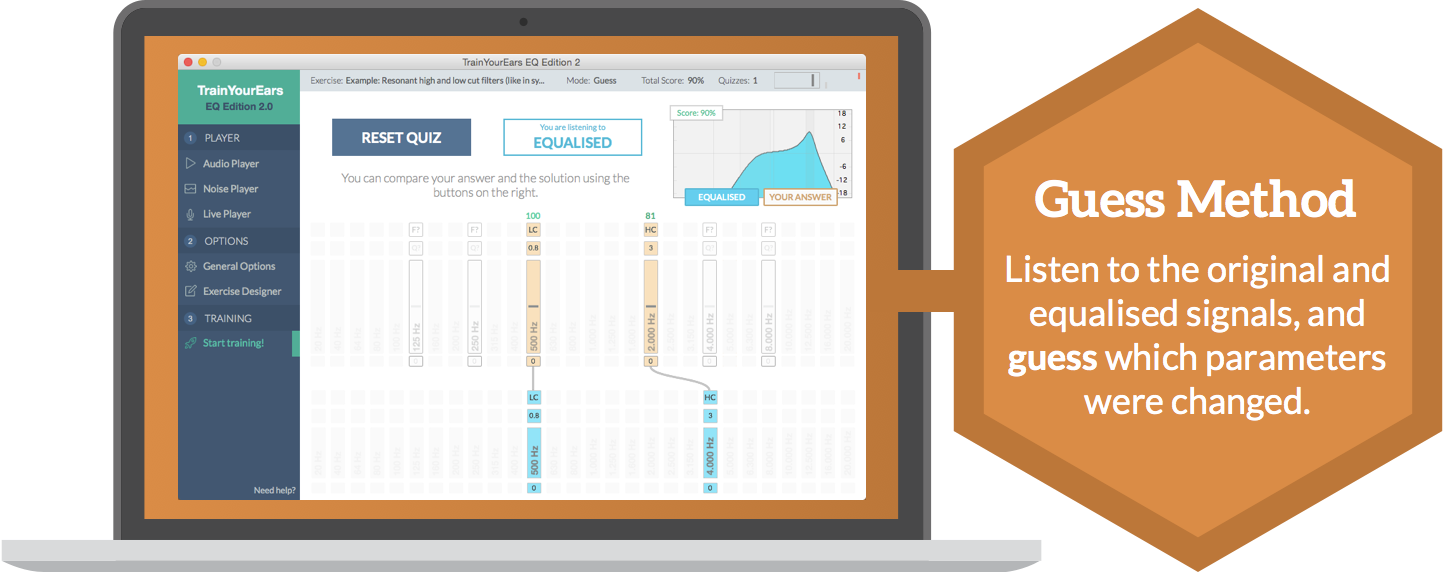
It speeds up your learning process exposing you to hundreds of random equalizations you have to guess. If you are wrong, it will let you know “how wrong”, and it will let you hear both your guess and the correct answer.
In no time you will develop a frequency memory which will allow you to connect the sound you imagine in your head with the parameters you need to dial, quickly and easily than ever.

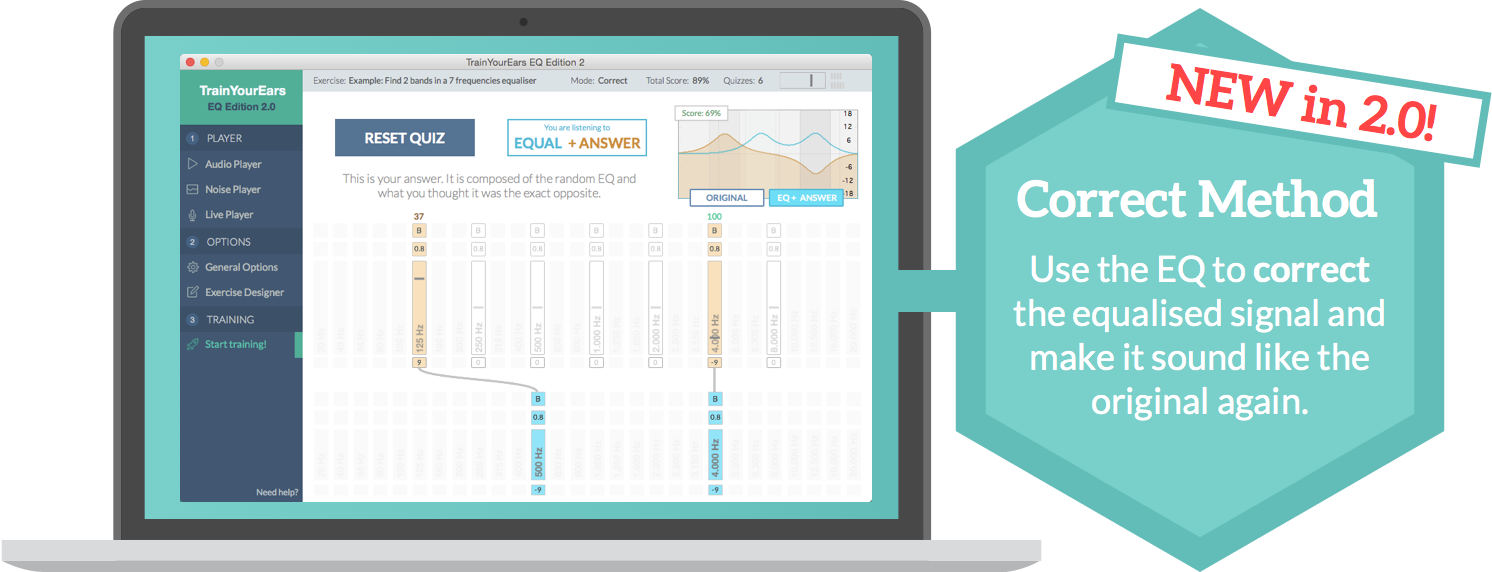
It has a brand new training method. Instead of guessing, you have to make corrections while you hear the result.
The person who suggested this method to us in the first place was Bob Katz, a renowned mastering guru. We tested it, we loved it, so here it is for all you to enjoy!
Besides it has a new, modern and clean interface, a new assisted training screen, a new exercise designer, it supports other languages, and many other features.
The ability to connect what is in your mind with the appropriate parameters you have to dial to get that sound is not an easy task. The steps involved should be:
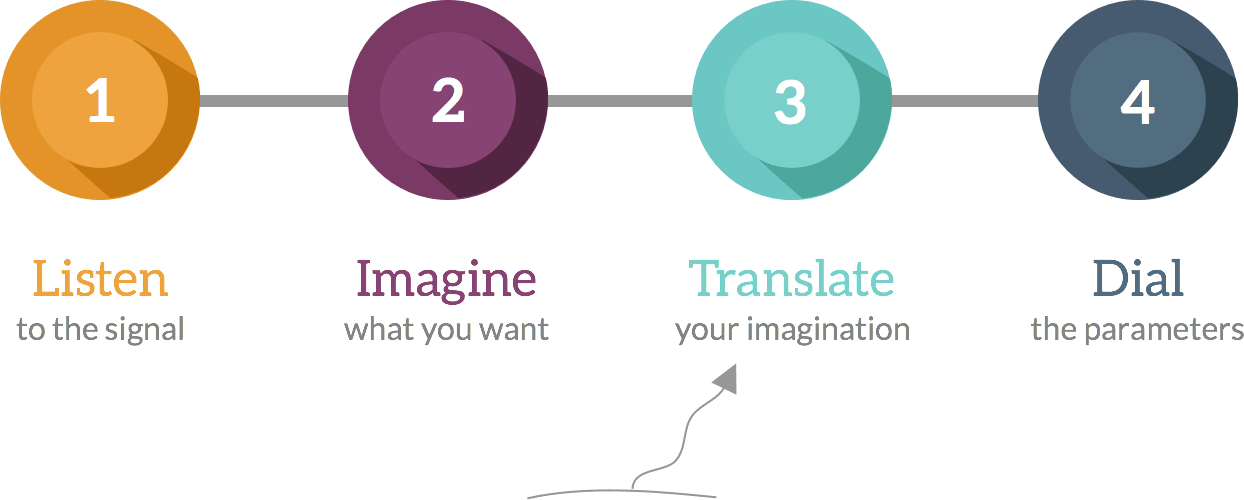
Sometimes people get lost in the translation step and start turning knobs without confidence. The more you work, the better you understand what those knobs really do, but it is a slow process.
People excel in this matter after many years, because they have learned experimenting with lots of different processes applied to lots of different sources. The purpose of this training is to open your ears to what each frequency sounds like and reduce the amount of time needed to acquire this knowledge.
In 15 minutes you can guess or correct 100 random equalisations, so training every day for a few weeks is equivalent to accumulating the experience of many years.
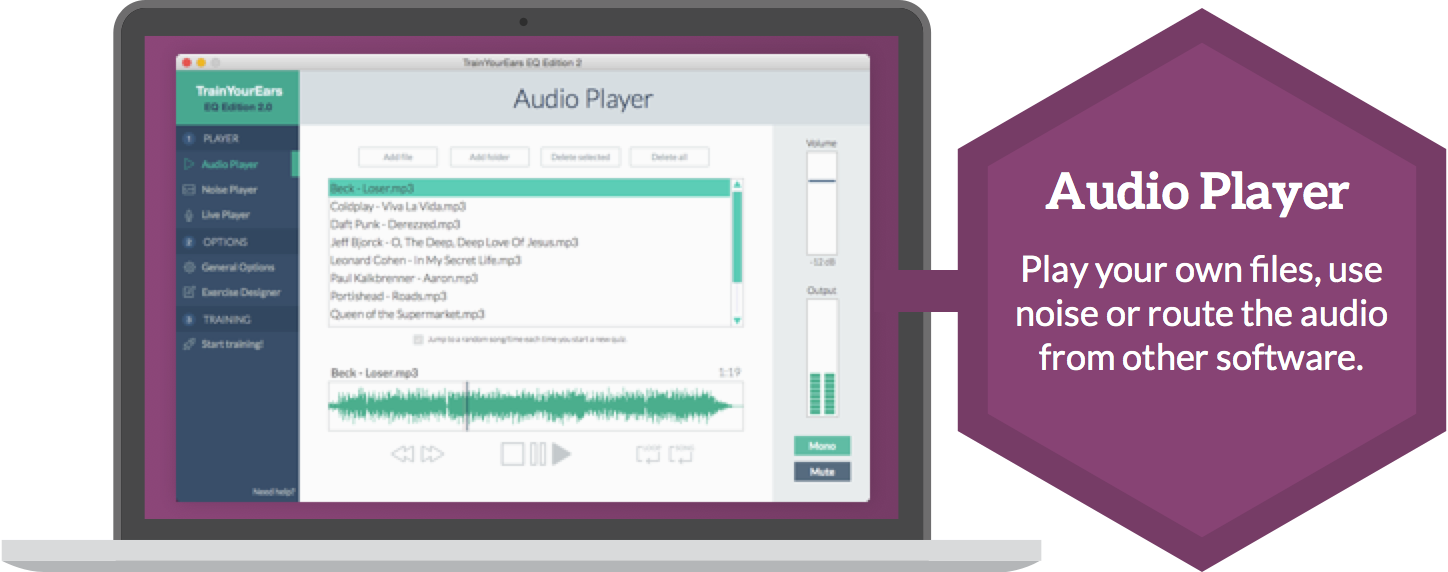
First, you load the music you want to train with:
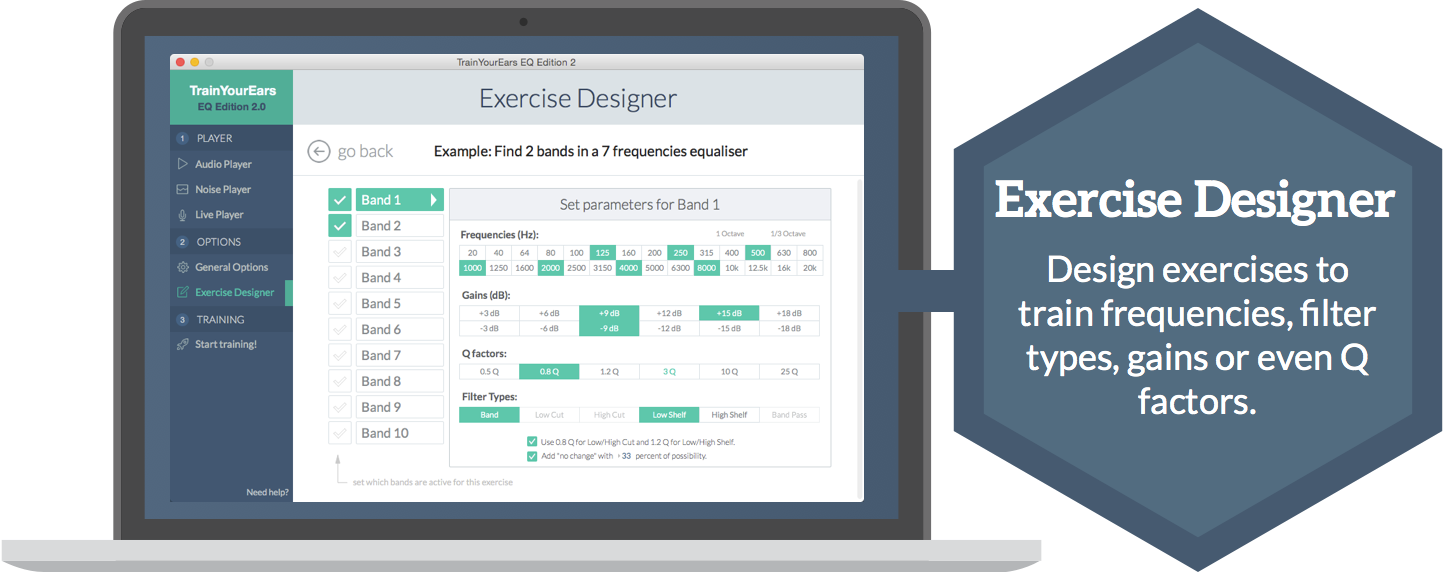
Then, you choose an exercise or design a new one:
And finally, train your ears with one of these two methods!
Wanna see more?
They watched the horizon until their lids grew heavy and the sea began to throw slow, soft shadows against the glass. Ruby told Lola about a time she had missed a ship and learned to befriend the dock's patience. Lola confessed she had once sent a postcard to an address she did not have, to see whether hope would find its way. They spoke of small mercies—the way a stranger returned a dropped glove, the way a song could reroute a day—and of the things they tended because they had no other homes: a cracked teacup, a neglected houseplant, an almost-forgotten promise.
At the lighthouse, the mayor took the microphone and saw the line of people and the knitted flags and the way children pointed at the splintered glass with fierce, innocent conviction. It is hard to vote against a town that remembers why something mattered. The plan to sell was shelved. The lighthouse remained, a patient witness.
Lola and Ruby kept doing what they had always done: trading maps for postcards, bread for stories, presence for absence. In rude summations they might have been described simply as friends, but that would miss the ledger of things they'd kept safe: ways of returning, rules for sending someone off without losing them, and the tiny architecture of daily rescue. They were infrastructure for each other—the kind that is often invisible until the lights go out—and they were, to the people who had watched them, proof that tenderness could be practical.
Lola discovered Ruby stitched maps into the lining of her coat—tiny, precise renderings of places the cloth had been. There were seashores with shells pinned like punctuation, a winter market where the stalls were painted in chalk, a rooftop where twenty-seven lanterns had once been hung for a midsummer dance. Ruby, in turn, discovered that Lola wrote initials on the backs of the postcards she left, small codes only she could remember: LP for small braveries, LM for weather apologies, L. for private triumphs. When Lola pressed a note into Ruby's palm, Ruby's fingers closed around the ink as if it were a delicate compass.
Their conversations did not rush. They peeled thoughts like fruit—there was no hurry to reach the core. Lola told Ruby how she used to collect the names of clouds when she was a child and how she believed names could steady a drifting thing. Ruby confessed she had been practicing the art of not explaining herself, not out of secrecy but to keep certain small, tender truths from being worn thin by translation. They both liked the quiet where sentences could breathe.
They watched the horizon until their lids grew heavy and the sea began to throw slow, soft shadows against the glass. Ruby told Lola about a time she had missed a ship and learned to befriend the dock's patience. Lola confessed she had once sent a postcard to an address she did not have, to see whether hope would find its way. They spoke of small mercies—the way a stranger returned a dropped glove, the way a song could reroute a day—and of the things they tended because they had no other homes: a cracked teacup, a neglected houseplant, an almost-forgotten promise.
At the lighthouse, the mayor took the microphone and saw the line of people and the knitted flags and the way children pointed at the splintered glass with fierce, innocent conviction. It is hard to vote against a town that remembers why something mattered. The plan to sell was shelved. The lighthouse remained, a patient witness. lola pearl and ruby moon
Lola and Ruby kept doing what they had always done: trading maps for postcards, bread for stories, presence for absence. In rude summations they might have been described simply as friends, but that would miss the ledger of things they'd kept safe: ways of returning, rules for sending someone off without losing them, and the tiny architecture of daily rescue. They were infrastructure for each other—the kind that is often invisible until the lights go out—and they were, to the people who had watched them, proof that tenderness could be practical. They watched the horizon until their lids grew
Lola discovered Ruby stitched maps into the lining of her coat—tiny, precise renderings of places the cloth had been. There were seashores with shells pinned like punctuation, a winter market where the stalls were painted in chalk, a rooftop where twenty-seven lanterns had once been hung for a midsummer dance. Ruby, in turn, discovered that Lola wrote initials on the backs of the postcards she left, small codes only she could remember: LP for small braveries, LM for weather apologies, L. for private triumphs. When Lola pressed a note into Ruby's palm, Ruby's fingers closed around the ink as if it were a delicate compass. They spoke of small mercies—the way a stranger
Their conversations did not rush. They peeled thoughts like fruit—there was no hurry to reach the core. Lola told Ruby how she used to collect the names of clouds when she was a child and how she believed names could steady a drifting thing. Ruby confessed she had been practicing the art of not explaining herself, not out of secrecy but to keep certain small, tender truths from being worn thin by translation. They both liked the quiet where sentences could breathe.
Final price was 89€, but the 49€ launch offer was such a success that we sold twice as many as we expected.
After a lot of thought we decided to keep this reduced price forever :)
Thanks to all the people who has supported this project so far and made this possible!




Trusted by thousands of students and teachers from the world’s top universities.