
Very Hot Mallu Aunty B Grade Movie Scene Mallu Bhabhi Hot With Her Boyfriend In Wet Red Blouse Link !!install!! -
In conclusion, Malayalam cinema and culture are intricately linked, reflecting the state's traditions, values, and social issues. The industry has produced a rich body of films that have gained national and international recognition, showcasing Kerala's cultural heritage and promoting cultural preservation and revival. As Malayalam cinema continues to evolve, it is likely to remain an integral part of Kerala's identity, influencing and reflecting the state's culture, values, and artistic expression.
One of the distinctive features of Malayalam cinema is its closeness to reality. Many films are set in rural Kerala and depict the everyday lives of ordinary people, making them relatable and authentic. The industry has a strong tradition of producing socially relevant films that tackle pressing issues such as poverty, inequality, and corruption. For instance, films like "Swayamvaram" (1972) and "Kuzhakku" (1984) highlighted the struggles of rural life, while "Papanasam" (2015) and "Take Off" (2017) addressed social issues like casteism and sexism. In conclusion, Malayalam cinema and culture are intricately
The industry has produced a diverse range of filmmakers who have made significant contributions to Malayalam cinema. Adoor Gopalakrishnan, known for his lyrical and poetic films like "Swayamvaram" and "Mathilukal," is a pioneer of Malayalam cinema. Other notable filmmakers include A. K. Gopan, known for his socially conscious films like "Nokketha Doorathu Kannum Nattu" and "Udyanapalakan"; and Lijo Jose Pellissery, recognized for his experimental films like "Eecha" (2012) and "Angamaly Diaries" (2017). One of the distinctive features of Malayalam cinema
Malayalam cinema has also been a platform for talented actors, who have gained a massive following across India. Mohanlal, one of the most celebrated actors in Malayalam cinema, has delivered iconic performances in films like "Purushanpokku" (1987) and "Kadal Meengal" (1993). Other notable actors include Mammootty, known for his versatility in films like "Ahimsa" (1987) and "Papanasam" (2015); and Dulquer Salmaan, recognized for his contemporary roles in films like "Second Show" (2012) and "Premam" (2015). For instance, films like "Swayamvaram" (1972) and "Kuzhakku"
The cultural significance of Malayalam cinema extends beyond the screen. The industry has influenced Kerala's music scene, with many film composers and singers contributing to the state's music heritage. The iconic Malayalam film songs, like "Mast Magan" from "2 States" (2014) and "Kaayalile" from "Drishyam" (2015), have become chartbusters. Moreover, Malayalam cinema has inspired a new generation of writers, artists, and intellectuals, who draw inspiration from the industry's themes, narratives, and characters.
In recent years, Malayalam cinema has gained international recognition, with films like "Take Off" and "Sudani from Nigeria" (2018) receiving critical acclaim at global film festivals. The industry's increasing global presence has not only promoted Kerala's culture but also encouraged collaborations and exchanges between filmmakers, actors, and technicians from different parts of the world.
eFatigue gives you everything you need to perform state-of-the-art fatigue analysis over the web. Click here to learn more about eFatigue.
Very Hot Mallu Aunty B Grade Movie Scene Mallu Bhabhi Hot With Her Boyfriend In Wet Red Blouse Link !!install!! -
Welds may be analyzed with any fatigue method, stress-life, strain-life or crack growth. Use of these methods is difficult because of the inherent uncertainties in a welded joint. For example, what is the local stress concentration factor for a weld where the local weld toe radius is not known? Similarly, what are the material properties of the heat affected zone where the crack will eventually nucleate. One way to overcome these limitations is to test welded joints rather than traditional material specimens and use this information for the safe design of a welded structure.
One of the most comprehensive sources for designing welded structures is the Brittish Standard Fatigue Design and Assessment of Steel Structures BS7608 : 1993. It provides standard SN curves for welds.
Weld Classifications
For purposes of evaluating fatigue, weld joints are divided into several classes. The classification of a weld joint depends on:
- the macroscopic geometry of the pieces welded,
- the direction of the cyclic stresses, and
- the location of the crack that leads to failure.
Two fillet welds are shown below. One is loaded parallel to the weld toe ( Class D ) and the other loaded perpendicular to the weld toe ( Class F2 ).
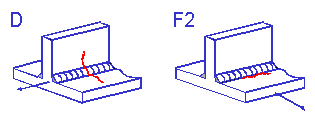
It is then assumed that any complex weld geometry can be described by one of the standard classifications.
Material Properties
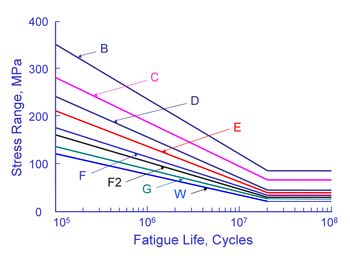
The curves shown above are valid for structural steel welds. Fatigue lives are not dependant on either the material or the applied mean stress. Welds are known to contain small cracks from the welding process. As a result, the majority of the fatigue life is spent in growing these small cracks. Fatigue lives are not dependant on material because all structural steels have about the same crack growth rate. The crack growth rate in aluminum is about ten times faster than steel and aluminum welds have much lower fatigue resistance. Welding produces residual stresses at or near the yield strength of the material. The as welded condition results in the worst possible residual or mean stress and an external mean stress will not increase the weld toe stresses because of plastic deformation. Fatigue lives are computed from a simple power function.

The constant C is the intercept at 1 cycle and is tabulated in the standard. This constant is much larger than the ultimate strength of the material.
The standard is only valid for fatigue lives in excess of 105 cycles and limits the stress to 80% of the yield strength. Experience has shown that the SN curves provide reasonable estimates for higher stress levels and shorter lives. In eFatigue, the maximum stress range permitted is limited by the ultimate strength of the material for all weld classes.
Design Criteria
Test data for welded members has considerable scatter as shown below for butt and fillet welds.
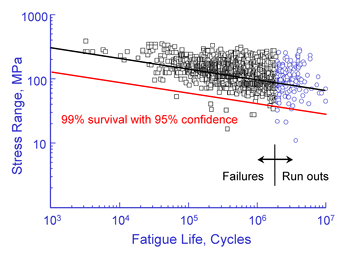
Some of this scatter is reduced with the classification system that accounts for differences between the various joint details. The standard give the standard deviation of the various weld classification SN curves.
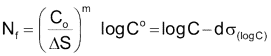
The design criteria d is used to determine the probability of failure and is the number of standard deviations away from the mean. For example d = 2 corresponds to a 2.3% probability of failure and d = 3 corresponds to a probability of failure of 0.14%.
© 2026 — Pure Scope